OSEI LAB


KNOWLDEGE TRANSLATION (KT)
Lung Disease Prevention
Although some risk factors for lung illness or disease might not be avoided, possessing a basic knowledge of risks can help improve adverse breathing conditions
These include:
-
Avoiding all forms of smoke by ceasing activities such as smoking cigarettes and e-cigarettes, avoiding second-hand smoke, and converting indoor fireplaces
-
Being ‘air-aware’ in and out by checking the Air Quality Health Index regularly, checking your home for radon, and keeping your home clean
-
Preventing sickness from yourself and your home via vaccinations, sanitizing your home and hands, covering coughs and wearing masks, as well as staying away from sick people
-
Taking action by staying active, talking to your healthcare provider and sticking to an Action Plan in case you live with a chronic lung disease such as Asthma, Chronic Obstructive Pulmonary Disease (COPD) or Interstitial Lung Disease
-
Last but the least, do not be a part of the problem via, protecting loved ones living with lung diseases, aiding kids and teenagers to avoid the dangers of smoking and vaping, not being idle or contributing to traffic-related air pollution (TRAP), protecting the environment to prevent wildfires etc.
-
Cough and sneezing into a tissue or your sleeve t prevent the spread of viruses and taking the proper vaccinations during flu season.
The 3Rs Research
Replacement
involves “Accelerating the development and use of predictive and robust models and tools, based on the latest science and technologies, to replace the use of animals in addressing important research questions where they would otherwise have been used.”
Reduction
includes “Appropriately designed and analysed animal experiments that are robust and reproducible and add to the knowledge base.”
Refinement
encompasses “Advancing laboratory animal welfare by exploiting the latest in vivo technologies to minimise pain, suffering and distress and improve understanding of the impact of welfare on scientific outcomes.”
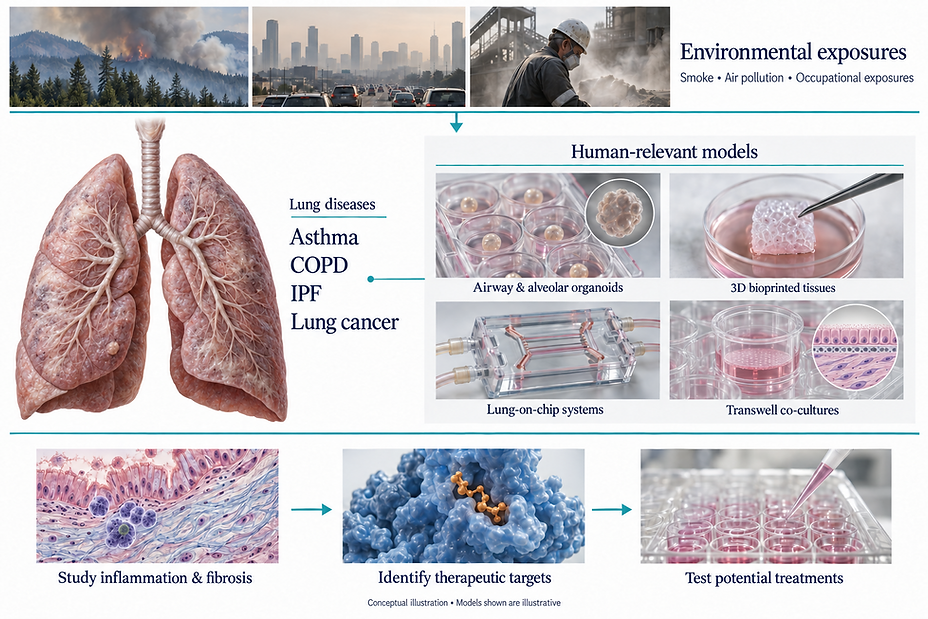
Human-relevant or Bioartificial (lung) models developed by the OSEI Lab are crucial tools for the 3R strategy in basic research and the development of new therapies. In line with this, in April 2025, the USA FDA announced a major plan to phase out animal testing requirements for monoclonal antibodies and other drugs (https://www.fda.gov/news-events/press-announcements/fda-announces-plan-phase-out-animal-testing-requirement-monoclonal-antibodies-and-other-drugs). It is therefore essential to develop bioartificial models that closely mimic the human body (e.g., lungs) for basic research and drug development. These models will be at the forefront of drug development in the coming years. The figure below illustrates how these human-relevant lung models connect environmental exposures and lung disease to mechanistic discovery and therapeutic testing.
From Human Lung Models to Therapeutic Discovery
Community Engagement
An independent news website interviewed Dr. Osei for the recent publication on our bioprinted vascularized airway model.
https://thetyee.ca/News/2025/09/08/Scientists-3D-Printed-Lung-Tissue/
